
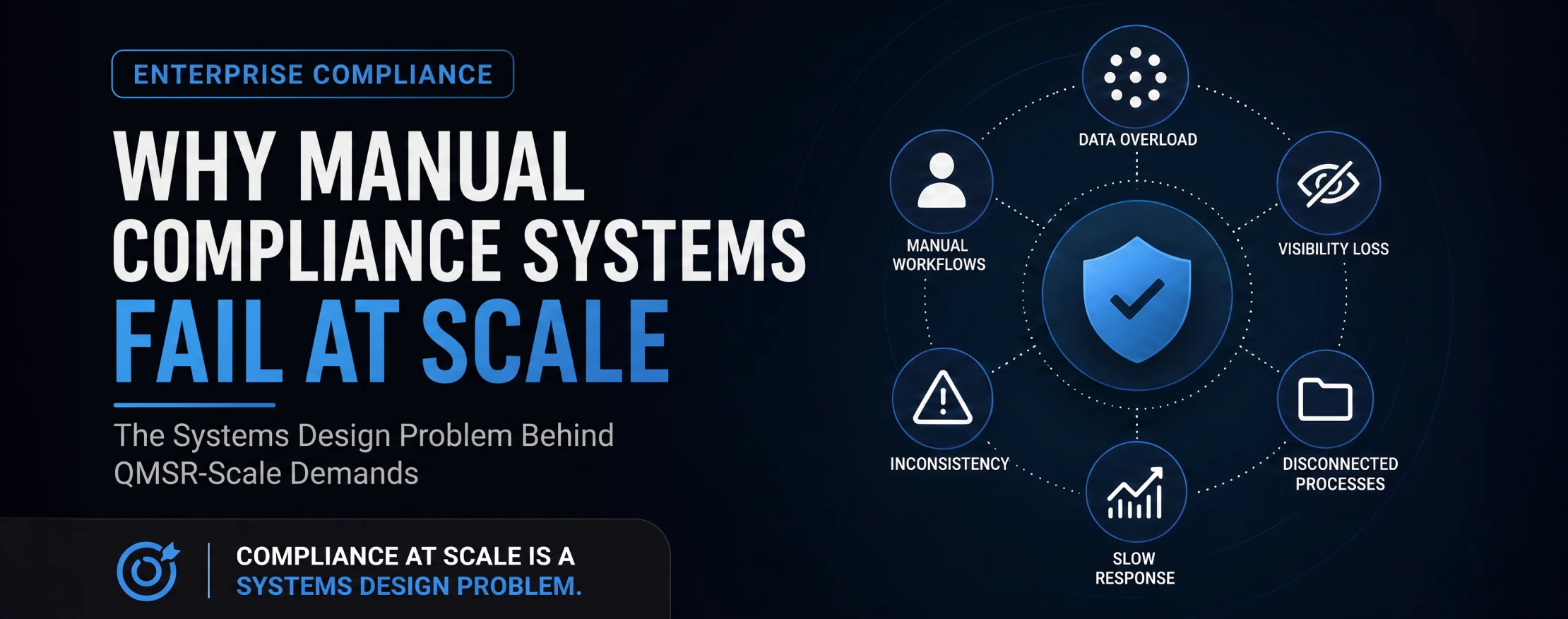
Compliance at scale is not a staffing problem.
It is a systems design problem.
Resilient Systems Series • Part Two
July 29, 2026
Scale is rarely linear
In complex adaptive systems, scale is rarely linear. Beyond a certain threshold, systems don’t simply get busier – they undergo a phase transition. Feedback loops tighten. Coupling between components increases. Predictability declines.
The organization on the other side of that threshold looks the same on the org chart. It behaves nothing like the one that entered it.
Most postmarket surveillance and complaint-handling functions were designed for the low-volume regime. That design worked, and it worked for a long time. The question worth asking now is whether the volume, data density and regulatory expectation your quality system faces in 2026 still belong to the regime it was built for.
At low volumes, humans absorb the variance
At low volumes, variation is manageable. Human judgment can reconcile weak signals. Manual controls can absorb noise. A quality engineer who has seen four hundred complaints on a product line carries a working model of that device in her head, and she can tell when something feels wrong before any threshold is formally breached.
That capability is real. It is also bounded.
As data density increases, the signal-to-noise ratio deteriorates. True anomalies become statistically harder to distinguish from normal variance. More complaints do not mean more clarity – they mean more surface area on which a genuine safety signal can hide behind ordinary fluctuation.
And here is the uncomfortable part: false confidence rises precisely when visibility is falling. Dashboards stay green. Reportability decisions still get made on time. The quality metrics that leadership reviews are all trending in the right direction, because those metrics measure throughput, not perception. The system feels controlled at exactly the moment it stops being able to see.
Manual workflows amplify the problem
Manual workflows don’t merely fail to help here. They actively make the failure mode worse.
When information lives in disconnected spreadsheets, shared inboxes, service logs, CAPA trackers and a folder of exported MAUDE queries, signals don’t aggregate. Three complaints across three sites, coded slightly differently by three reviewers, are three isolated events. Structurally connected, they may be one emerging hazard.
The evidence on consistency is sobering. On ambiguous IMDRF Annex coding, human reviewers agree with each other only 56–71% of the time. That variance isn’t a training gap. It’s what happens when judgment is applied at volume without a shared structural substrate – and it means the same underlying event can enter your system under three different identities and never reconcile.
In complex systems, aggregation is everything
Weak signals only become visible when they are structurally connected.
This is the point most compliance models quietly fail on. Not because people lack capability – the people are usually excellent — but because the system was never architected for nonlinear scale. It was architected to process items. Processing items faster does not produce aggregation. It produces a faster-moving fog.
Aggregation requires that a complaint, an adverse event, a service record, a field report and a literature signal can be evaluated against one another – pinned to the same device identity, mapped to the same coding frame, and connected to the risk file that is supposed to govern them all. Absent that, every signal is evaluated alone, and the system’s effective sensitivity is set by whatever a single reviewer can hold in working memory.
What QMSR actually changed
The regulatory frame moved in the same direction the systems logic points.
The FDA’s Quality Management System Regulation harmonizes US requirements with ISO 13485, and in doing so it shifts the expectation from documented procedure to integrated, risk-based postmarket surveillance. EU MDR made the same move earlier through Articles 83–87. FDA’s consolidation of legacy adverse-event databases into a single real-time platform points the same way: continuous, connected, current.
Under the old frame, the question a compliance system had to answer was did we route, evaluate and report this complaint correctly and on time?
Under QMSR, that question is necessary and no longer sufficient. The question is:
Does this signal change the risk?
That is not a workflow question. It is a systems question, and it cannot be answered by any component that only sees one complaint at a time. Answering it requires the risk profile, the hazard matrix, the reportability posture and the live complaint stream to be one connected object rather than five artifacts that get reconciled quarterly by hand.
Resilient systems are not the ones that work harder
The instinctive response to a threshold crossing is effort: more analysts, more overtime, a bigger backlog burn-down, a consultant engagement. This buys time. It does not change the regime.
Resilient systems are not those that work harder under pressure. They are those architected to:
- Sense continuously – not in batches, and not only when a threshold is formally tripped
- Integrate across boundaries – across sites, sources, geographies and regulatory frames
- Adapt before instability compounds – closing the loop while the signal is still weak enough to be cheap to act on
Those three properties are architectural. They cannot be added by working the existing architecture harder, which is why organizations that respond to a phase transition with staffing typically find the relief temporary.
Systems either evolve intentionally, or they transition unintentionally
That is the whole argument, and it is not a metaphor.
A compliance system that is not deliberately redesigned for nonlinear scale will still change — under audit finding, under a missed vigilance deadline, under a signal that was visible in the aggregate data for eleven months and visible to no individual reviewer on any single day. The transition happens either way. The only variable is whether you chose it.
Compliance, at scale, is a systems design problem.
empowerreg builds the intelligence layer that makes aggregation structural – connecting complaints, adverse events, MAUDE, EUDAMED and field data into one continuously evaluated safety picture, mapped to QMSR, EU MDR, IMDRF and ISO 13485. In pilot, on deliberately degraded production data, the platform reached 3.8 minutes per complaint end to end with 95–100% agreement with expert reviewers on the safety-critical determinations.