
Why Lifecycle Integration Is the Real Regulatory Shift
Resilient Systems Series • Part Two
May 21, 2026
This is the answer.
Most conversations about QMSR and EU MDR focus on new templates and new terminology. Which clause maps to which procedure. What the PSUR has to contain. Whether the design history file needs restructuring.
That work is real. It is also not the shift.
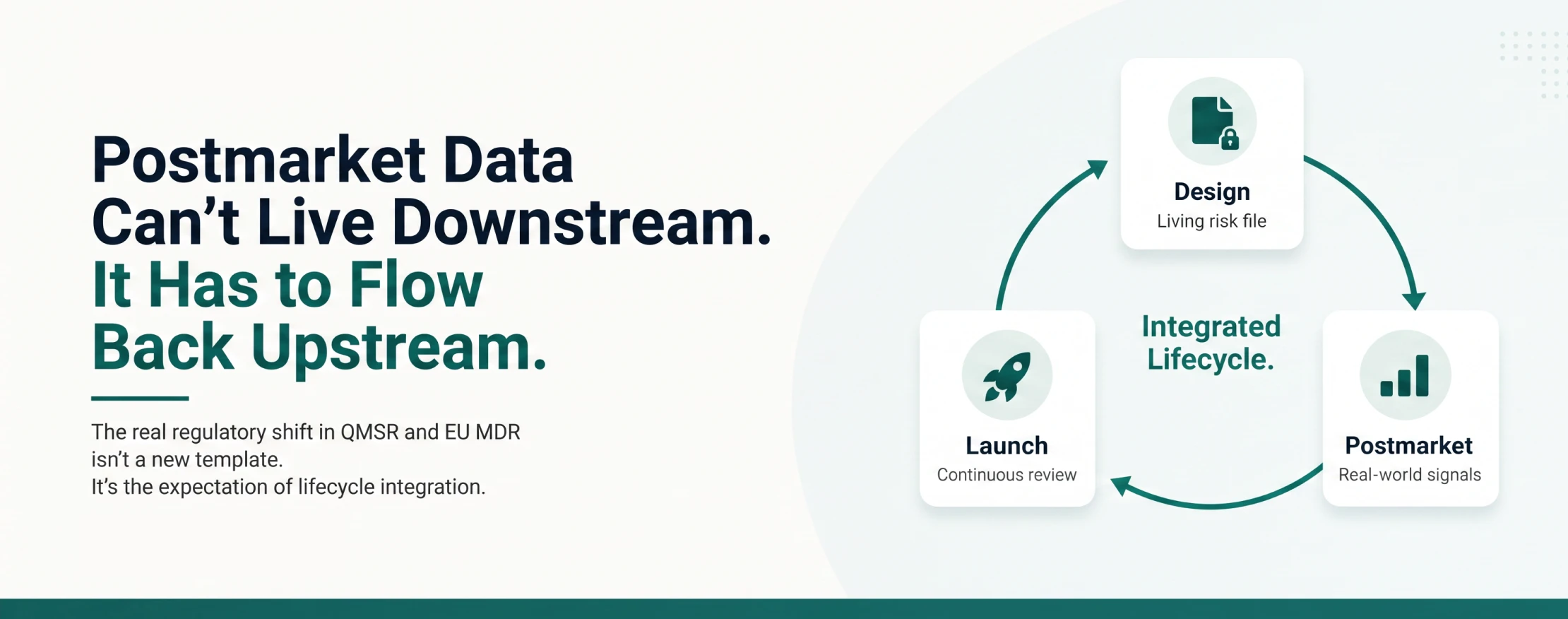
The real shift is in the expectation of lifecycle integration: data collected after market launch must actively inform risk management, design decisions, and benefit–risk assessment.
Not annually. Not at the next design review. Continuously.
Postmarket data can no longer live downstream. It has to flow back upstream.
This is written into the standards, not implied by them
It’s worth being precise here, because “lifecycle integration” can sound like consultant vocabulary rather than a requirement with a citation.
ISO 14971 does not treat risk management as an activity that concludes at launch. Production and post-production information feeds back into the risk management process as a defined, continuous obligation – the risk file is a living artifact that the real world is entitled to revise. QMSR’s alignment with ISO 13485 imports that expectation into US requirements directly.
EU MDR builds the same loop explicitly and then closes it: PMS data feeds the PMS report and PSUR, which feed the clinical evaluation and PMCF, which feed the benefit–risk determination in Annex I, which governs whether the device may remain on the market at all. Each arrow in that chain is a regulatory requirement, not a best practice.
Read together, the frame is unambiguous. The regulator’s model of your quality system is a loop. If your organization’s actual information flow is a line – design, launch, then a separate downstream function that handles what comes back – you are operating a different system than the one you are being assessed against.
Why it matters
1. Risk hides in the seams
The most dangerous failures don’t happen inside any single function. They happen in the handoffs – between complaints and design, between PMS and clinical evaluation, between field performance and the next iteration.
This is the awkward property of interface failures: every function can pass its own audit while the organization as a whole is blind. Complaint handling is meeting its timelines. Design controls are documented. The CER is current. Each function looks healthy in isolation, and the risk is living entirely in the space between them, which no function owns and no metric measures.
Functional excellence is not a defense here. It can be the disguise.
2. Weak signals die in transit
A subtle pattern noticed during complaint review only matters if it reaches the people making design decisions — with enough fidelity to act on.
Watch what actually happens to a signal on that journey. A reviewer reads a narrative describing an unusual failure mode and notes something odd in the free text. That narrative gets coded to a category. The category gets counted into a trend. The trend becomes a line on a quarterly slide. The slide gets summarized in a governance meeting.
Four transformations, each one reasonable, and the thing that was actually informative – this failed in a way we did not anticipate – was destroyed at step two. What arrives upstream is a number that is within tolerance.
When lifecycle stages are loosely coupled, signals don’t merely travel slowly. They arrive stripped of exactly the texture that made them worth sending.
3. Decisions get made on stale evidence
Benefit–risk is not a launch-day calculation. It shifts the moment a product meets real-world conditions – different user populations, different reprocessing practices, different concomitant devices, different care settings than the ones in the clinical evidence.
Organizations that treat the original risk file as the source of truth are making today’s decisions with yesterday’s data. And regulators are increasingly pointed about this: the question in an inspection is no longer whether a risk file exists, but when it was last revised and what evidence drove the revision. A risk file that hasn’t moved since launch is not a sign of a stable product. It is a sign of a severed loop.
The asymmetry is getting worse, too. As adverse-event reporting infrastructure consolidates toward real-time platforms, the regulator’s view of your device’s postmarket performance updates continuously. If yours updates quarterly, you are not just behind — you are behind on your own data.
What lifecycle integration actually means
Resilient systems do one thing exceptionally well: they connect experience, evidence, and action across time.
That’s the whole definition. Not a new diagram on a wall. Not a software purchase. A deliberate rewiring of how information moves – so that what the field learns on Tuesday is capable of changing what engineering decides in Q3, without depending on whether the right person happened to be in the right meeting.
Practically, that rewiring has three properties:
- Signals retain context in transit. The narrative travels with the code, so the thing that made the event unusual survives the trip upstream.
- The risk file is downstream of live data, not upstream of it. Complaint-to-risk linkage is continuous and automatic, not a reconciliation exercise performed before an audit.
- The loop has a shorter period than the drift it’s meant to catch. Quarterly review cannot detect a pattern that becomes an event in six weeks.
The organizations getting ahead of this aren’t waiting for an inspection to expose the seams. They’re closing them now – while it’s a design decision rather than a finding.
Where this fits
This is the next layer of what we’re building at empowerreg: helping teams turn lifecycle integration from a compliance expectation into an operating advantage.
The compliance case is straightforward. The operating case is more interesting. An organization whose postmarket data genuinely reaches its design decisions doesn’t just pass audits more comfortably – it iterates on better information than its competitors, because it knows what its product does in the world rather than what it was specified to do. The same wiring that satisfies a Notified Body is the wiring that tells you which failure mode to engineer out of the next generation.
Lifecycle integration is a regulatory requirement. It is also, for anyone who builds it properly, a compounding advantage.
One question worth taking to your next quality review: where in your lifecycle do signals get lost in translation – and would anyone notice if they did?
Ready to See It in Action?
If you'd like to see what a closed loop looks like on your own safety data:
hello@empowerreg.ai