
Quality Failures Don't Stay in Quality
Part 1 traced how safety signals fragment across eight disconnected systems, why the signal usually lives in the relationships between records rather than inside any one of them, and what QMSR and EU MDR now expect of a post-market surveillance system. It ended on the most visible consequence of falling behind: a 483 or a warning letter becomes public the moment it's filed, and the market reads it before the company can respond.
Resilient Systems Series • Part Two
March 18, 2026
That’s the cost with a timestamp on it.
This piece is about the rest of it – the costs that never arrive as a single event, and therefore never get budgeted for.
Most manufacturers budget for the tip
Every manufacturer has a number for what a PSUR costs. It is almost always the direct FTE cost, because that is the part finance can see:
- Regulatory affairs – PSUR authoring and coordination
- Quality / PMS – complaint review and trending
- Clinical / Safety – AE analysis and benefit–risk input
- Data / IT – exports and reconciliation
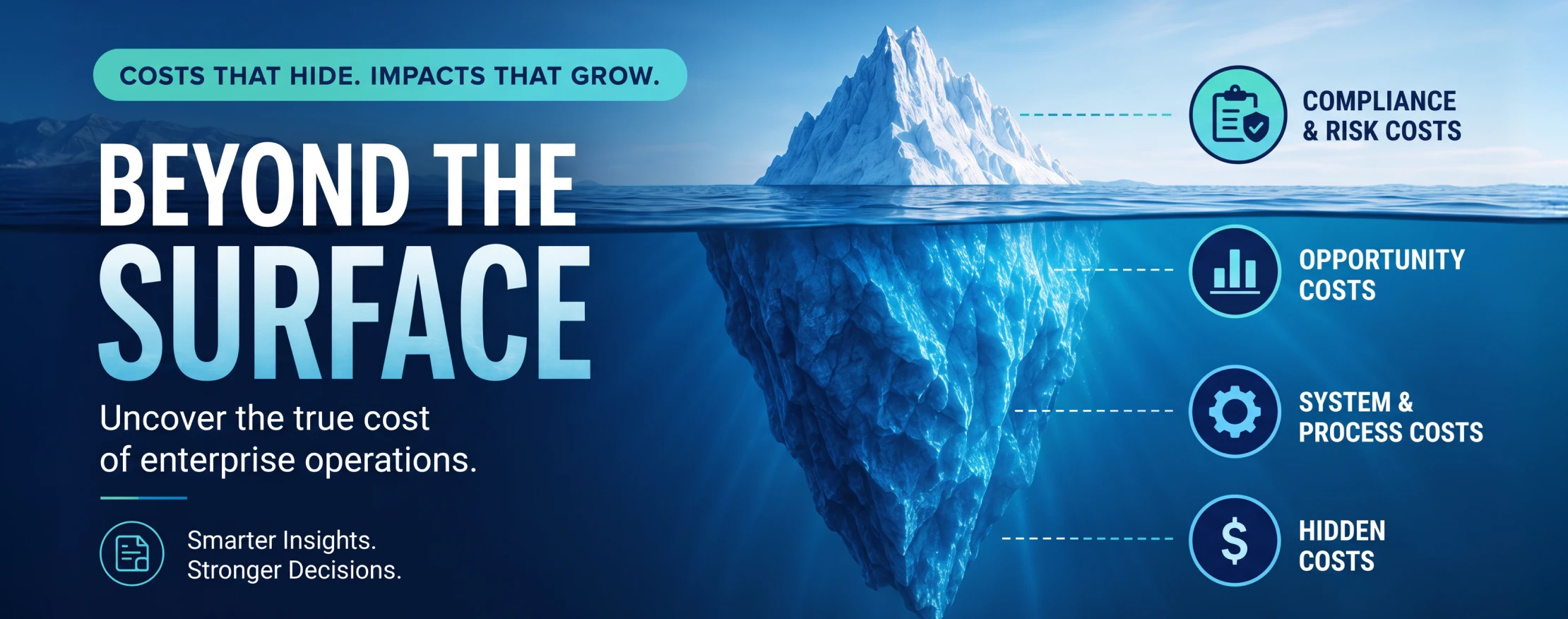
This is where most cost models stop. Below the waterline sit three categories that rarely make it into a business case.
Compliance and risk costs. Audit observations, and the firefighting, patchwork systems and CAPAs they generate. Report rework caused by inadequate trending. Certificate delays from Notified Body questions, and the market loss that follows. Submission delays from technical file gaps.
Opportunity costs. Market delays and the revenue that goes with them. Clinical input consumed by literature search and CER/PMCF delays. Regulatory affairs bandwidth becoming the organization’s bottleneck, which quietly means less innovation. Management focus pulled into strategic drift and corporate image work.
System and process costs. Data silos and disconnected tools. Manual Excel work, with its errors and its fatigue. Repeated work that produces no workflow gains cycle over cycle. And no traceability, which means no analytics – the compounding cost of never being able to learn from your own history.
Then the same effort repeats. For PMCF. For trending. For the CER. For the next PSUR.
The tip is an annual line item. The iceberg is a permanent operating condition, and almost nobody has a number for it.
Where the bill actually lands
Here is the argument that changes the conversation with a CFO.
The cost of a PMS failure shows up in the QMS first and on the P&L second. By the time it reaches the board, every commercial function is already paying – and none of them have “quality” in their name.
Sales pays first
Hospitals and GPOs pause decisions on any active finding. Competitors cite your public letters in bid responses – your compliance record becomes their sales collateral. Existing customers demand CAPA plans before re-orders, elongating every cycle. Distributors renegotiate terms, or quietly exit.
None of this appears in a quality metric. All of it appears in the pipeline.
Marketing writes down brand equity
Years of accumulated trust take a hit inside a single 24-hour news window. Active investigations freeze campaigns and PR plans that were budgeted quarters ago. Crisis communications spend crowds out demand generation.
And then the long tail: headlines outrank your owned content in search results for years. You do not get to decide when that ends.
R&D pays the remediation tax
Your best engineers get reallocated to CAPA work instead of new products. 510(k) and PMA timelines slip while the backlog clears. Competitors close the gap while you remediate – the gap doesn’t reopen just because you finished.
And the people who are best at this work are the ones with the most options. Sustained fire drills are how you lose them.
Connected Evidence isn’t a quality investment. It’s a commercial defense system – and the CFO is starting to see what the CRO already feels.
The inversion
If you accept all of that, one thing has to change structurally.
Today, in most organizations, trend intelligence sits at the end of the process. Complaints are handled, coded, reported, and then – eventually, quarterly, retrospectively – trended. Trending is what you do to the data after the work is finished.
It should be the opposite. Trend intelligence shouldn’t end the process. It should drive it.
When a connected risk signal emerges — detected, contextualized and explainable — it should be capable of triggering any of eight downstream actions:
- Risk file review | CAPA opened |
- Regulatory reporting | Labeling review |
- Training | Design feedback |
- Investigation | Management review |
That is what a closed loop looks like in operation. Not a report that describes what happened. A signal that decides what happens next.
It is also the difference between a PMS function that costs money and one that returns it. A retrospective trend report is a compliance artifact. A signal that reaches design before the next production run is an engineering input.
What this does and doesn’t ask of people
None of this is an argument for automating judgment away.
The operating model is human-led, AI-enabled, systems-preserved:
- AI listens, connects, suggests and explains.
- Humans decide, provide feedback, and train the system.
- Systems preserve the trace and maintain consistency.
AI here is connective tissue. Not a chatbot, not a dashboard, and not a replacement for the reviewer who knows the device.
That distinction matters more in this domain than in almost any other, because the output of this work is a regulatory decision that has to be defensible years later, by a named human, against a documented rationale. A system that produces good answers without preserving why is not an asset. It’s a liability with better throughput.
The aggregation is what humans demonstrably cannot do at volume – holding eight data sources, a decade of precedent and three regulatory frames in working memory at the moment of a single coding decision. The judgment is what they do better than any system. Building for the first without displacing the second is the entire design problem.
The goal
Compliance and commercial performance have been treated as opposing budget lines for as long as this industry has existed. One protects you; the other grows you; and every dollar spent on the first is a dollar the second doesn’t get.
The QMSR era is where that stops being true.
The same architecture that lets you answer a Notified Body’s question in an afternoon is the architecture that tells you which failure mode to engineer out of the next generation, which geography is drifting, and which signal is worth acting on before it becomes a headline. The organizations that build it will spend less on compliance and know more about their own products than the organizations that don’t. Those are not two projects.
In Part 1, this series opened with Gladys Knepper, who died in June 2024 at 93 after her pacemaker battery failed six months before the recall, and years after failures had reportedly appeared in the manufacturer’s own factory testing. The signals existed. Nothing connected them in time.
We cannot bring her back. What we can do is make sure the next signal is seen in time.
The goal is not to automate responsibility. The goal is to strengthen it.
empowerreg is a Health Safety Intelligence company. CMPMS™ delivers AI-driven complaint intake, triage and investigation with IMDRF coding and human-in-the-loop automation; risk mapping linked to product families; defensible reportability decision trees for MDR, EU MDR vigilance and Health Canada; signal detection and trending across the device portfolio; and export-ready PMS reports, PSURs and submissions.